
• Certified & Qualified Gas Technicians
• Full Gas Leak Detection & Safety Testing
• 15+ Years Appliance Repair Experience
• Same-Day Gas Stove Repairs Durban
• Residential & Commercial Gas Systems
A gas stove fault is not something to ignore or attempt to fix yourself. A burner that will not ignite, a flame that goes out when you release the knob, a weak or uneven flame or a gas smell from your stove are not just inconveniences — they are potential safety hazards that require the attention of a certified gas technician. At the same time, a gas stove that is not working properly means your family cannot cook, and you need it fixed today.
Appliance Repairs Durban has been repairing gas stoves across all Durban areas for 22 years. Our certified technicians are trained and qualified to work on gas appliances in compliance with South African gas safety regulations, including the SANS 10087 standard that governs domestic gas installations and appliances in South Africa. We carry gas stove parts, gas compliance documentation and safety testing equipment in our fully-equipped mobile units across Durban, and we repair all gas stove faults safely, correctly and in most cases on the same day you call.
Gas stoves have become increasingly popular in Durban homes as a practical load shedding solution. A gas hob continues to function during power outages and is completely immune to load shedding surge damage. However, gas appliances require a higher standard of maintenance and repair than electric appliances because the consequences of an incorrectly repaired gas appliance go beyond a failed repair. Our certified technicians bring the specific knowledge, equipment and compliance documentation that every gas stove repair in Durban demands.
Every gas stove repair we complete comes with a full written quote before any work begins, genuine OEM parts, a gas work compliance certificate where applicable and a 6-month workmanship guarantee. Our call-out fee is R350, waived if you proceed with the repair. No hidden charges. No surprise bill. Just fast, safe and professional gas stove repairs from the team Durban has trusted since 2003.
WhatsApp +27 79 976 2941 — We Reply Within Minutes
Call +27 79 976 2941
Mobile units available today — all Durban areas
Gas smell from your stove? Turn off the cylinder valve, ventilate the area and WhatsApp us immediately
Before looking at the faults we repair, it is important to address gas safety because a gas stove in an unsafe condition requires specific actions before a technician arrives.
Do not attempt to use the stove or ignite any burner
Do not operate any electrical switches, including light switches, anywhere in the area
Turn off the gas supply at the cylinder valve immediately
Open all windows and doors to ventilate the area thoroughly
Leave the building if the gas smell is strong
Move to a safe location before using your mobile phone to contact us
WhatsApp or call us once you are safely outside
Do not re-enter until the area has been thoroughly ventilated and a certified technician has confirmed the appliance is safe
Turn the burner knob off immediately
Check that the gas cylinder valve is open and the cylinder is not empty
Check that the burner cap is correctly seated
Do not attempt to repair the igniter or gas valve yourself
Contact us for a same-day repair across Durban
Turn the burner knob off immediately
Allow any accumulated gas to disperse for 60 seconds before attempting to relight
If the flame continues to go out when you release the knob, the thermocouple is likely faulty and needs repair
Never attempt to bypass, override or repair any gas component yourself. Gas appliance repairs must be carried out by a certified technician. Incorrect gas repairs can result in gas leaks, fire and carbon monoxide poisoning.
Our certified technicians diagnose and repair all gas stove faults across Durban, including freestanding gas cookers, built-in gas hobs, combination gas and electric stoves and commercial gas ranges.
This is the most common gas stove fault. A burner does not ignite when the knob is turned and held, and the clicking sound of the igniter may or may not be present depending on the cause.
The igniter produces the spark that lights the gas at the burner. On most modern gas stoves, all burners share a single igniter module, so when it fails all burners usually stop igniting simultaneously. On older designs, each burner may have its own igniter. Igniter module failure is especially common after load shedding surge damage.
The ceramic igniter tip must be clean and dry to produce a reliable spark. Food spills, grease and water can weaken or prevent spark production. In Durban’s humid climate, igniter tips become contaminated more quickly than in drier areas.
The small holes around the edge of the burner head allow gas to flow to the spark point. Food spills and grease can block these holes and stop ignition.
The burner cap must sit flat and correctly centred on the burner head. If it is out of place, the spark may not reach the gas properly.
The wiring between the igniter module and individual burner igniters can be damaged by heat, spills or rodent activity. This often causes one burner to fail while the others still ignite normally.
This is the classic sign of a faulty thermocouple. The thermocouple is a safety device that generates a small electrical voltage when heated by the burner flame. This voltage keeps the gas valve open. If the thermocouple fails or produces too little voltage, the valve closes as soon as the knob is released.
Normal wear over time
Carbon build-up on the thermocouple tip
Physical damage or corrosion
Incorrect positioning in the flame
Gas valve solenoid fault requiring both thermocouple and valve attention
Thermocouple replacement is usually a straightforward same-day repair. Do not try to bypass the thermocouple by holding the knob in permanently.
A burner that ignites but produces a weak, low or uneven flame usually has a gas supply or burner condition fault.
An almost-empty gas cylinder causes lower pressure and weak flames across all burners.
A failing regulator causes inconsistent or insufficient pressure, leading to weak flames and unstable burner performance.
If some burner holes are blocked, the flame will be uneven, strong in some places and absent in others.
Using the wrong burner cap on the wrong burner can distort the flame pattern and affect ignition and heating.
A gas valve that does not open fully can restrict gas flow and produce a weak flame.
A gas smell from the stove, whether the burners are on or off, indicates a gas leak that requires immediate attention.
Faulty gas valve that does not fully close
Deteriorated supply hose
Loose or failed gas connections
Cracked burner body
Any gas smell should be treated seriously. Do not try to locate or repair a gas leak yourself.
A gas smell while the burner is operating normally usually means incomplete combustion. This can produce carbon monoxide and unburnt hydrocarbons.
Incorrect air-to-gas ratio
Blocked air holes in the burner venturi
Incorrectly sized burner components
Gas supply pressure that is too high
If your gas stove produces a persistent gas smell during normal use, make sure the kitchen is well ventilated and contact us immediately.
A gas stove where the igniter keeps clicking after the burner is lit usually has a moisture or contamination fault.
Wet igniter tip after cleaning or a boil-over
Failed igniter module switch stuck in the closed position
A burner that does not maintain the selected flame height usually has a gas supply pressure problem or a gas valve fault.
Fluctuating cylinder pressure
Failing gas valve
Partially blocked burner that restricts flow as it heats up
We publish our gas stove repair pricing openly.
This covers your certified technician travelling to your Durban home, inspecting the gas stove, diagnosing the fault and providing a full written quote. It is waived if you proceed with the repair.
These commonly include:
Igniter module replacement
Individual igniter replacement
Thermocouple replacement
Burner cap and head cleaning and service
Igniter wiring repair
Burner cap replacement
Gas supply hose replacement
Gas connection tightening and leak testing
These commonly include:
Gas valve replacement
Gas pressure regulator replacement
Complete igniter system overhaul
Wiring harness repair or replacement
Built-in gas hob control board replacement
Gas manifold repair or replacement
Complete gas safety inspection and certification
Included where applicable. All gas work carried out by our certified technicians is accompanied by the correct gas compliance documentation where required.
Parts are quoted separately at cost price and require your written approval before we order or fit anything.
Repair is almost always the right decision. Gas stoves are mechanically simpler than electric stoves and generally have fewer expensive electronic components.
Apply the Rule of 50. If the repair costs more than 50 percent of what a comparable new gas stove would cost, replacement is usually the smarter long-term decision.
Major repairs on very old gas stoves may not give good long-term value, and some older units may not meet current South African gas safety standards.
Average gas stove lifespan: 15 to 20 years for quality models under normal South African conditions. Gas stoves are also less affected by load shedding than electric stoves, making them a strong long-term choice in Durban.
Our certified technicians repair all major gas stove brands across Durban, including:
Defy
Smeg
Bosch
AEG
Siemens
Whirlpool
Electrolux
Candy
Hisense
Beko
Zanussi
Miele
Neff
Hotpoint
KIC
Samsung
LG
Do not see your brand? WhatsApp us on +27 79 976 2941 — we most likely repair it.
Self-contained units with gas burner hobs and either gas ovens or combination gas-and-electric oven configurations.
Separate gas hobs built into kitchen counters. We safely access and repair built-in units without damaging surrounding cabinetry.
These are increasingly popular in Durban because they offer a practical solution during load shedding. We repair both the gas hob and electric oven sections.
We also repair commercial gas ranges, industrial gas hobs and commercial gas ovens for restaurants, hotels and catering businesses across Durban.
Our mobile units cover the entire Durban metro daily. Same-day gas stove repairs are available across:
Umhlanga, La Lucia, Durban North, Ballito, Tongaat, Mount Edgecombe, Phoenix and Verulam
Berea, Morningside, Musgrave, Glenwood, Overport, Durban CBD, Sydenham and Greyville
Bluff, Isipingo, Amanzimtoti, Montclair, Wentworth, Yellowwood Park, Malvern and Merebank
Pinetown, Westville, Hillcrest, Kloof, Chatsworth, Queensburgh, New Germany and Gillitts
Not sure if we cover your suburb? WhatsApp us your area on +27 79 976 2941 and we will confirm within minutes.
Gas stove repairs require a certified technician trained to work on gas appliances in compliance with South African regulations. We never send an uncertified technician to a gas stove callout.
Every gas stove repair begins with a safety assessment. Our technicians carry gas leak detection equipment and test all gas connections before, during and after every repair.
Where required, we provide the correct gas compliance certificate so your gas work meets safety standards and insurance requirements.
We have been repairing gas stoves across Durban since 2003 and understand the specific brands, faults and conditions most common in local homes.
A family without a working gas stove cannot prepare a meal. Our mobile units cover all Durban areas every day and carry the most common gas stove parts for same-day repairs in most cases.
You receive a full written quote before any repair starts. Labour and parts are itemised separately. No hidden fees.
Every gas stove repair we complete comes with a 6-month workmanship guarantee in writing.
Our call-out fee is R350 and is waived if you proceed with the repair. Minor gas stove repairs usually cost between R450 and R900, while major repairs usually range from R900 to R2,500. Parts are quoted separately at cost price and you always receive a full written quote first.
In most cases yes, as long as there is no gas smell. If there is any smell of gas from the non-functioning burner, stop using the stove completely, turn off the cylinder valve and contact us immediately.
This is usually caused by a failed igniter module. Most modern gas stoves use one igniter module for all burners, so when it fails, all burners stop sparking.
Gas burners themselves are not affected by load shedding, but the electronic ignition system, igniter module, clock, timer and display can all be damaged by surge events when power returns.
For repairs involving valves, regulators, gas manifolds or new gas connections, yes. For smaller repairs like igniter or thermocouple replacement, it depends on the exact work done. We advise you and provide the correct documentation where required.
Signs include weak flames across all burners, flame height that changes during cooking, a gas smell from the regulator, visible frosting on the regulator and inconsistent pressure. A faulty regulator should always be replaced by a certified technician.
A yellow or orange flame usually indicates incomplete combustion, often caused by blocked air inlets, the wrong burner cap, pressure problems or partially blocked burner holes. This can create carbon monoxide risk and should be checked promptly.
A quality thermocouple usually lasts around 3 to 5 years under normal domestic use, although heavy use, dirt, carbon build-up and incorrect positioning can shorten its lifespan.
Yes. We repair gas stoves connected to both LPG and natural gas. We can also convert many stoves between LPG and natural gas using the correct gas jets and settings.
Yes. We repair commercial gas stoves, restaurant ranges, industrial gas hobs and commercial gas ovens across all Durban areas. Commercial gas stove failures are treated as priority callouts because a kitchen without a working gas range cannot operate.
If your gas burner will not ignite, the flame goes out when you release the knob, your stove smells like gas or the flame is weak or uneven, do not ignore the problem.
Appliance Repairs Durban provides fast, safe and professional gas stove repairs across all Durban areas by certified gas technicians.
Call +27 79 976 2941
WhatsApp +27 79 976 2941
Same-day gas stove repairs in Durban from a team you can trust.

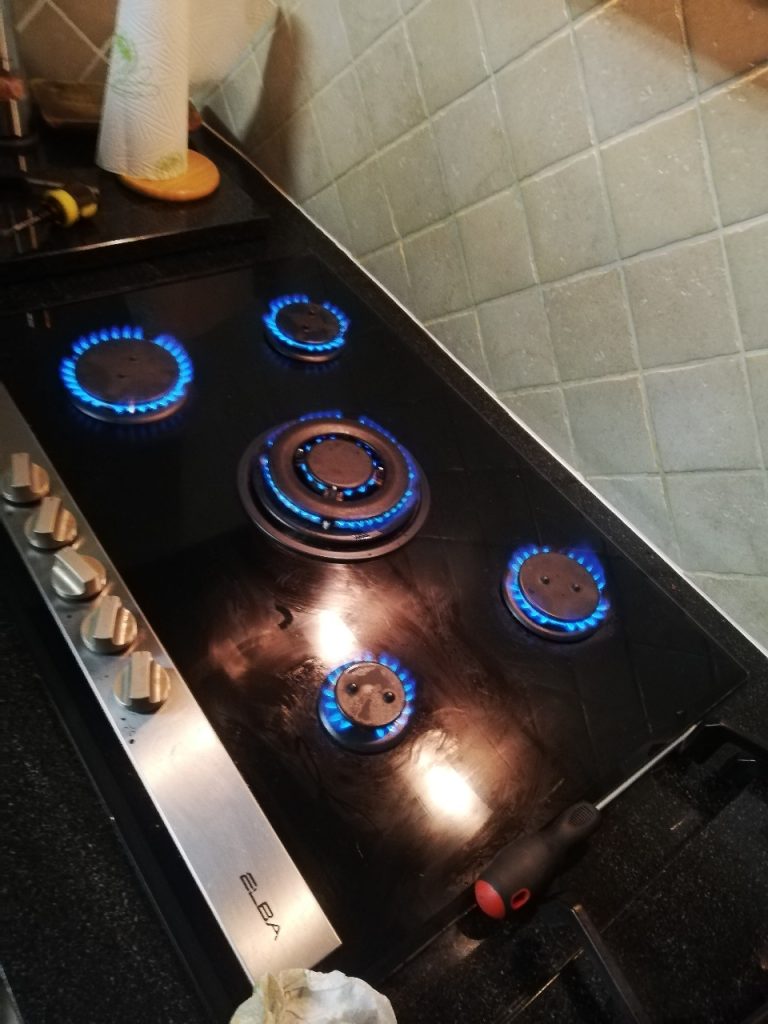
A gas stove fault is not something to leave or attempt to fix yourself. Whether your burners will not ignite, the flame goes out when you release the knob, you have a weak flame or you can smell gas — you need a certified gas technician at your door today. Not tomorrow. Not after the weekend.
Our certified gas technicians are in fully-equipped mobile units across Durban right now — carrying igniter modules, thermocouples, gas valves and regulators for all major gas stove brands. We arrive, conduct a full safety check, diagnose accurately, repair correctly and confirm every burner is safe before we leave. Every gas stove repair comes with a gas compliance certificate where applicable and a 6-month workmanship guarantee in writing.
⚠️ If you can smell gas right now — turn off the cylinder valve, open all windows and doors, leave the building and WhatsApp us from a safe location outside. Do not operate any electrical switches.
For all other gas stove faults — ignition failure, thermocouple fault, weak flame, clicking igniter — call or WhatsApp us now:
💬 WhatsApp +27 79 976 2941 — We Reply Within Minutes
📞 Call +27 79 976 2941
Gas stove repairs require a higher standard of process than any other appliance repair — because safety must be confirmed at every stage before, during and after the repair. Here is exactly what happens from the moment you contact us to the moment your gas stove is repaired, tested and confirmed safe.
Step 1 — Contact Us by WhatsApp or Phone
Call or WhatsApp us on +27 79 976 2941. Tell us:
• Your suburb in Durban
• Your gas stove brand, type and model if you have it — freestanding gas cooker, built-in gas hob, combination gas and electric stove or commercial gas range
• The fault or symptoms you are experiencing — burner not igniting, flame going out when knob is released, weak flame, gas smell, igniter clicking constantly, flame yellow or orange
• Whether there is a gas smell — if yes we give you immediate safety instructions before anything else
• Whether the fault affects one burner or all burners — this single piece of information significantly narrows the likely fault cause before the technician arrives
• Whether the fault started after a load shedding outage — load shedding surge damage to the igniter module is the most common cause of all burners failing to ignite simultaneously
For any gas smell or safety concern we give you immediate safety instructions the moment you contact us — before we discuss the repair. Your safety is the first priority on every gas stove callout.
Immediate safety advice for gas smell callouts:
• Turn off the gas cylinder valve immediately
• Do not operate any electrical switches
• Open all windows and doors to ventilate the area
• Leave the building if the smell is strong
• Move to a safe location before contacting us
• Do not re-enter until the area is ventilated and our technician has confirmed it is safe
We respond within minutes and confirm same-day availability for your Durban area. Our mobile units carry igniter modules, thermocouples, gas valves and regulators for all major gas stove brands — in most cases the correct part is on board before the technician leaves our depot.
What happens at this step:
• We respond within minutes
• Gas smell — immediate safety instructions given before anything else
• Same-day availability confirmed for your Durban area
• Fault details noted — single burner or all burners, gas smell or no smell, post-load shedding or gradual fault
• Correct parts and gas safety equipment prepared for dispatch based on the fault description
• No deposit and no commitment required
Step 2 — A Certified Gas Technician Is Dispatched to Your Door
A certified gas technician in a fully-equipped mobile unit is dispatched to your home or business — in most cases on the same day you contact us. The key word is certified. Gas stove repairs must be carried out by a person of competence under South African gas safety regulations — SANS 10087. Every technician we dispatch to a gas stove callout carries the correct gas work certification and brings the appropriate safety equipment and compliance documentation.
Our mobile units carry everything required to diagnose and repair the majority of gas stove faults in a single visit:
Gas stove parts on board:
• Igniter modules for all major gas stove brands — Defy, Smeg, Bosch, AEG, Siemens, Whirlpool, Electrolux, Candy, Hisense, Beko and more
• Individual igniter electrodes for burner-specific ignition faults
• Thermocouples — all lengths and configurations for all major brands
• Gas pressure regulators — LPG and natural gas specifications
• Gas supply hoses — rubber and braided stainless steel
• Gas valves for common gas stove brands
• Burner caps and heads for major brands
• Igniter wiring and connectors
Gas safety equipment on board:
• Electronic gas leak detector — detects LPG and natural gas at concentrations well below the lower explosive limit
• Pressure gauge set for gas supply pressure measurement
• Gas compliance documentation and certificate forms
• Personal protective equipment for gas work
What happens at this step:
• Certified gas technician dispatched — gas work certification confirmed before dispatch
• Mobile unit carries gas stove parts and full gas safety equipment
• Gas leak detection equipment on board — used before and after every gas stove repair
• You are informed of who is coming and their estimated arrival time
Step 3 — Arrival Safety Check — Before Any Diagnosis Begins
This step is unique to gas stove repairs and distinguishes a professional gas stove callout from a general appliance repair. Our technician does not begin diagnosis until a safety check has confirmed the situation is safe to proceed:
Arrival safety assessment:
• Gas smell assessment on arrival — the technician assesses whether there is any gas odour in the kitchen or surrounding area before entering
• Electronic gas leak detection — the electronic gas detector is used to confirm whether gas is present in the space at detectable concentrations before any work begins
• Gas cylinder valve status confirmed — is the cylinder valve open or closed
• Ventilation confirmed — the kitchen is adequately ventilated before any inspection of gas components begins
If gas is detected on arrival:
• The kitchen is ventilated before any work begins
• All sources of ignition are eliminated from the area
• The gas cylinder valve is confirmed closed or is closed by the technician before proceeding
• The leak source is located using the electronic gas detector and soapy water applied to all connections
• Only once the gas source is identified and the atmosphere is confirmed clear does diagnostic and repair work begin
If no gas is detected on arrival:
• The safety check is completed and documented
• Diagnosis proceeds immediately
This safety check is not optional and is not skipped under any circumstances regardless of how straightforward the reported fault appears. A gas stove repair that begins without a safety check is a gas stove repair that is not being handled correctly.
What happens at this step:
• Electronic gas leak detection performed on arrival — before any other work
• Gas smell and cylinder valve status assessed
• Ventilation confirmed adequate before gas component inspection
• If gas detected — area cleared and leak source identified before diagnosis proceeds
• Safety check documented — part of the compliance record for the job
Step 4 — Systematic Gas Stove Diagnosis and Full Written Quote
Once the safety check has confirmed it is safe to proceed our technician conducts a systematic diagnosis of the gas stove fault. The diagnostic approach is methodical — working from the gas supply through to the individual burner components to identify the exact fault cause:
Gas supply assessment:
• Gas cylinder — weight assessed, cylinder valve confirmed open, cylinder not empty
• Gas pressure at stove inlet — measured with pressure gauge and confirmed within the correct range for the stove specification. Low pressure indicates a failing regulator or a nearly empty cylinder. High pressure indicates a failed regulator allowing excessive pressure through.
• Gas supply hose — inspected for deterioration, cracking, kinking or damage. Soapy water applied to all hose connections to confirm gas tightness.
• Regulator — inlet and outlet pressures measured, regulator body inspected for physical damage or evidence of venting through the relief valve.
Ignition system diagnosis:
• Igniter module — voltage output measured at the module terminals. A failed module produces no output voltage or reduced output voltage. Module failure confirmed or ruled out before individual igniter testing.
• Individual igniters — each burner igniter tested for correct spark production with the module confirmed functional. An igniter that does not spark with correct module voltage has failed individually.
• Igniter tips — each tip inspected for contamination, cracking, moisture and correct clearance from the burner cap. Contaminated tips cleaned and retested before recommending replacement.
• Igniter wiring — continuity tested at each burner igniter connection. A broken wire at one burner causes that burner only to fail while all others continue to ignite normally.
• Igniter module switches — the switches in the control knobs that activate the igniter when pressed in are tested for correct operation. A switch that does not activate the igniter when pressed or that does not release after the knob is released is identified as a fault.
Thermocouple diagnosis:
• Each thermocouple tested for correct voltage output using a millivolt meter — the standard diagnostic tool for thermocouple assessment
• Thermocouple output compared against the minimum voltage required to hold the gas valve open for the specific stove model — a thermocouple producing below the threshold voltage causes the flame to go out when the knob is released
• Thermocouple tip position confirmed — the tip must be correctly positioned in the burner flame to achieve the correct operating temperature and voltage output
• Thermocouple tip condition assessed — carbon build-up cleaned and thermocouple retested before recommending replacement
Gas valve diagnosis:
• Each gas valve tested for correct operation — opening when the knob is depressed and turned, remaining open when thermocouple voltage is applied and closing completely when the knob is returned to the off position
• A valve that does not close completely — indicated by a gas smell with the burner off — is identified as failed and requires immediate replacement
• A valve that does not open fully — indicated by a weak flame that does not respond to the control knob — is identified as blocked or failing
Burner condition assessment:
• All burner caps removed and inspected for blockage, damage and correct seating
• Burner holes inspected and cleared where blocked
• Burner bodies inspected for cracking or damage
• Burner caps replaced and seating confirmed correct before reassembly
Flame quality assessment on functional burners:
• Each functional burner ignited and flame colour, height and evenness assessed
• A predominantly yellow or orange flame indicates incomplete combustion — air inlet blockage or incorrect gas pressure identified as the cause
• Flame height compared against the expected height for the knob position — low flame at full-open position indicates gas supply or valve restriction
After completing the full diagnosis our technician will:
• Explain exactly what is wrong with each fault in plain language
• Show you the faulty component where possible — a thermocouple with a carbon-coated tip, a cracked igniter ceramic, a failed module
• Provide a full written quote itemising labour and parts separately for all identified faults
• Advise on whether all identified faults should be repaired in the same visit — for example replacing all thermocouples at the same time as one has failed is often more cost-effective than returning for individual thermocouple replacements as they fail progressively
• Confirm whether a gas compliance certificate is required for the work to be performed
No work begins until you have given your written approval. If you are not happy with the quote you pay only the R350 call-out fee and the technician leaves — no pressure and no obligation.
What happens at this step:
• Gas supply fully assessed — cylinder, pressure, hose, regulator
• Ignition system fully diagnosed — module, individual igniters, wiring, switches
• Thermocouples tested with millivolt meter — voltage output confirmed against specification
• Gas valves tested — opening, holding and closing confirmed
• Burners inspected and cleaned as part of diagnosis
• Flame quality assessed on functional burners
• All fault causes confirmed with testing — not guesswork
• Full written quote — labour and parts itemised separately
• Compliance certificate requirement confirmed
• No work begins without your written approval
Step 5 — Gas Stove Repaired Using Genuine Parts and Correct Procedures
Once you approve the quote repair begins. All gas work is carried out in compliance with South African gas safety regulations — SANS 10087. Genuine OEM parts are used on every repair. Where OEM parts are not available high-quality approved replacement parts of the correct specification are used.
Typical repair times for common gas stove faults:
Igniter module replacement — 30 to 60 minutes:
• Gas supply turned off at cylinder before igniter module work begins
• Failed module disconnected from all burner igniter wires and control knob switches
• New module connected — correct polarity confirmed at each connection
• All wire connections insulated and secured
• Gas supply restored and all burners tested for ignition
Individual igniter replacement — 20 to 40 minutes per burner:
• Failed igniter disconnected and removed
• New igniter fitted and positioned correctly relative to burner cap
• Igniter lead connected and secured
• Burner tested for correct spark production and ignition
Thermocouple replacement — 20 to 40 minutes per burner:
• Gas supply turned off at cylinder
• Failed thermocouple removed from burner mounting and gas valve connection
• New thermocouple fitted — correct length and configuration for the burner
• Thermocouple tip positioned correctly in the burner flame zone
• Gas valve connection made — correct thread engagement confirmed
• Gas supply restored — burner lit and thermocouple heating time confirmed before knob release test
Gas valve replacement — 45 to 90 minutes per valve:
• Gas supply turned off at cylinder — confirmed with gas detector before valve work begins
• Gas pressure fully relieved from the stove manifold
• Failed valve removed — all connected components including thermocouple lead and igniter wire disconnected
• New valve fitted — correct specification for the burner size confirmed
• All connections remade — thermocouple lead and igniter wire reconnected
• Soapy water applied to all disturbed connections before restoring gas supply
• Gas supply restored — all connections confirmed gas tight with electronic detector and soapy water
• Burner lit and tested for correct operation — ignition, flame stability and shut-off confirmed
Gas regulator replacement — 30 to 60 minutes:
• Gas cylinder valve turned off
• Old regulator removed from cylinder valve
• New regulator fitted — correct pressure specification for LPG or natural gas confirmed
• All hose connections made and confirmed gas tight
• Gas supply restored — outlet pressure measured and confirmed within the correct range for the stove specification
Gas supply hose replacement — 20 to 40 minutes:
• Gas cylinder valve turned off
• Old hose removed — both cylinder end and stove inlet end disconnected
• New hose fitted — correct length and pressure rating confirmed
• Both connections made and confirmed gas tight with soapy water and electronic detector
• Gas supply restored
Built-in gas hob repairs — add 20 to 40 minutes to all estimates above for the time required to safely lift and access the hob within the kitchen counter top installation without damaging the surrounding cabinetry or counter top surface.
For repairs where a specific part needs to be ordered:
• We inform you of the lead time upfront — typically 1 to 3 business days for common gas stove parts
• The part cost is included in your approved written quote
• We advise on whether the stove can be safely used in the interim — in some cases other burners can continue to be used while waiting for a part for a single faulty burner
• We schedule a return visit as soon as the part arrives
• No additional labour is charged for the return visit
What happens at this step:
• All gas work carried out in compliance with SANS 10087 South African gas safety regulations
• Genuine OEM or correct specification approved parts used on every repair
• Gas supply isolated before any gas component work — confirmed with gas detector
• All disturbed connections tested for gas tightness with soapy water before gas supply is restored
• Electronic gas detector used to confirm no gas leakage after every connection is made
• Most gas stove repairs completed in a single visit
• No additional charges beyond the approved written quote
Step 6 — Post-Repair Safety Testing — Every Repair Confirmed Safe Before the Technician Leaves
The post-repair safety test is the most important step and is never shortened or skipped. A gas stove repair is not complete until every component has been confirmed to be operating correctly and safely.
Post-repair gas tightness test:
• Electronic gas detector passed over every gas connection that was disturbed during the repair — cylinder connection, regulator outlet, hose connections, stove inlet connection and all gas valve connections
• Soapy water applied to all connections — bubbles at any connection point indicate a leak that must be addressed before the technician leaves
• Gas tightness confirmed — zero gas detected at any connection point — before proceeding to burner testing
Burner ignition testing:
• Every burner tested for reliable ignition — each burner lit three consecutive times to confirm consistent ignition performance
• Igniters confirmed to spark correctly on knob press and to stop clicking immediately after the burner lights
• Burners confirmed to ignite on the first or second spark attempt — a burner requiring more than three attempts to ignite has a residual fault that is investigated before the technician leaves
Thermocouple testing:
• Each repaired thermocouple tested by lighting the burner, allowing the thermocouple to heat for the correct time and then releasing the control knob
• Flame confirmed to remain lit after the knob is released — thermocouple voltage output confirmed sufficient to hold the gas valve open
• Each burner tested three consecutive times to confirm consistent thermocouple performance
Flame quality assessment:
• Each burner flame assessed for correct colour — predominantly blue with small yellow tips
• Flame height confirmed correct at all knob positions — low, medium and high
• Flame confirmed even around the full circumference of the burner — no dead spots or uneven distribution
• No flame lift-off at high gas pressure setting
• No yellow or orange flame indicating incomplete combustion
Gas valve shut-off testing:
• Each gas valve confirmed to close completely when the knob is returned to the off position
• Gas detector passed over each burner in the off position to confirm zero gas flow through a closed valve
• A valve that does not close completely is replaced before the technician leaves — this is non-negotiable on a gas stove repair
After the post-repair safety test is complete and all components are confirmed safe our technician will:
• Confirm verbally that the stove is safe to use and explain what repairs were performed
• Issue the gas compliance certificate where applicable — documenting the gas work performed, the gas appliance details and the technician’s certification reference
• Issue the 6-month workmanship guarantee in writing — covering all labour and workmanship
• Provide maintenance advice specific to your gas stove — burner cleaning frequency, thermocouple inspection intervals, gas supply hose replacement schedule and gas supply safety checks
• Advise on gas safety best practices — cylinder storage, hose inspection, what to do in the event of a gas smell
• Process payment — cash, EFT or card accepted
What happens at this step:
• Electronic gas detector confirms zero gas leakage at all connections before burner testing
• Soapy water test confirms all connections gas tight
• Every burner tested three consecutive times for reliable ignition
• Every thermocouple tested — flame confirmed to remain lit after knob release
• Flame quality assessed — correct colour, height and evenness confirmed
• Every gas valve confirmed to close completely — gas detector confirms zero flow in off position
• Gas compliance certificate issued where applicable
• 6-month workmanship guarantee issued in writing
• Maintenance and gas safety advice provided
• Payment processed — cash, EFT or card accepted
Our Promise on Every Gas Stove Repair in Durban
A gas stove repair is not a routine appliance call. It requires certified technicians, correct safety equipment, systematic diagnosis, compliant repair procedures and thorough post-repair safety testing. We have been repairing gas stoves across Durban for 22 years because we do every step of this process correctly — every time, on every job. You will not be left with a gas stove that has not been confirmed safe. You will not be left with a compliance certificate from an uncertified technician. And you will not be left without a 6-month guarantee on every repair we perform. That is our commitment on every gas stove callout across every suburb in Durban.
1. What is the difference between LPG and natural gas and can my gas stove use both?
Understanding the difference between LPG and natural gas is important for gas stove maintenance and repair — because a stove configured for one gas type cannot simply be connected to the other without modification:
LPG — liquefied petroleum gas — is the most common gas type used in Durban homes. LPG is stored under pressure as a liquid in portable cylinders — the familiar blue or orange gas cylinders found in South African homes. When the cylinder valve is opened the LPG vaporises and flows to the stove as a gas. LPG is a mixture of propane and butane and operates at a higher pressure than natural gas — typically 2.8 kPa through the stove regulator.
Natural gas — also called reticulated gas or piped gas — is supplied through a fixed pipe network directly to the property. Natural gas is predominantly methane and operates at a lower pressure than LPG — typically 1.0 to 2.0 kPa. Natural gas is available in some Durban suburbs through the Egoli Gas or similar distribution networks. Natural gas has the advantage of an uninterruptible supply — no cylinder emptying at an inconvenient moment.
Can a gas stove use both? Not without modification. The two gases have different energy content and flow characteristics — a stove configured for LPG has gas jet orifices sized for LPG flow rates. If connected to natural gas without changing the jets the flame will be weak and incomplete combustion will occur — producing a yellow flame and potentially carbon monoxide. Converting a gas stove between LPG and natural gas requires replacing the gas jets — the small orifice fittings in each burner — with the correct size for the other gas type. Our certified technicians carry jets for both gas types and perform gas stove conversions across Durban in compliance with SANS 10087. WhatsApp us on +27 79 976 2941.
2. How do I correctly light a gas burner that has a faulty igniter using a match or lighter?
If your gas stove igniter has failed and you need to use the stove while waiting for a repair visit our certified technicians advise the following procedure for safely lighting a gas burner manually — this is a temporary measure only and the igniter fault should be repaired as soon as possible:
Safety considerations before manual lighting: • Manual lighting requires you to bring a flame source close to the burner before turning the gas on — or simultaneously. Never turn the gas on first and then bring the flame — accumulated gas ignites explosively. • Ensure there is no gas smell in the kitchen before attempting manual lighting — a gas smell indicates a leak that must be addressed before any ignition attempt • Ensure the kitchen is adequately ventilated • Keep children away from the stove during manual lighting
Correct manual lighting procedure:
Do not use manual lighting as a permanent solution — a faulty igniter should be repaired by a certified technician. WhatsApp us on +27 79 976 2941 for a same-day igniter repair across Durban.
3. What is carbon monoxide and how does a gas stove produce it?
Carbon monoxide — CO — is a colourless, odourless, tasteless gas that is produced when any carbon-containing fuel burns incompletely. Unlike the distinctive smell of LPG or natural gas you cannot detect carbon monoxide without a dedicated detector — which is why it is known as the silent killer.
How a gas stove produces carbon monoxide: Gas stoves produce carbon monoxide when the gas does not burn completely. Complete combustion of LPG or natural gas produces carbon dioxide and water vapour — neither of which is harmful in normal concentrations. When combustion is incomplete — due to insufficient oxygen, incorrect gas pressure or a dirty burner — carbon monoxide is produced instead of carbon dioxide.
Specific gas stove conditions that produce excessive carbon monoxide: • Yellow or orange flame — a flame that is not predominantly blue is burning incompletely and producing carbon monoxide • Blocked air inlets on the burner venturi — restricts the air supply required for complete combustion • Incorrect gas pressure — either too high or too low causes incomplete combustion • Cooking in an unventilated kitchen for extended periods — even a correctly functioning gas stove produces some carbon monoxide. Adequate ventilation is essential. • Blocked or partially blocked burner holes causing uneven combustion
Carbon monoxide poisoning symptoms — headache, dizziness, nausea, confusion and fatigue. Symptoms are often mistaken for flu. If multiple people in the household experience these symptoms simultaneously during or after gas stove use ventilate the property immediately, exit the building and contact emergency services.
Practical protection measures: • Install a carbon monoxide detector in your kitchen — a basic detector costs between R200 and R500 and provides potentially life-saving early warning • Always ensure adequate kitchen ventilation when using a gas stove — open a window or ensure the extractor fan is running • Have your gas stove serviced by a certified technician annually — a correctly maintained and adjusted gas stove produces minimal carbon monoxide • Never use a gas stove as a space heater — running a gas stove in a closed room to generate warmth is extremely dangerous
If your gas stove is producing a yellow or orange flame WhatsApp us on +27 79 976 2941 for a same-day assessment across Durban.
4. How do I check if my gas cylinder is empty or nearly empty?
A gas cylinder that runs out during cooking is a common frustration — but there are several ways to monitor gas levels and avoid being caught out:
The hot water method — the most reliable low-tech test:
The weight method: • Every gas cylinder has its tare weight — the weight of the empty cylinder — stamped on the collar at the top of the cylinder • Weigh your cylinder on a bathroom scale and subtract the tare weight — the result is the weight of LPG remaining • A standard South African 9kg cylinder contains 9kg of LPG when full. A 19kg cylinder contains 19kg when full. • A cylinder with less than 15 to 20 percent of its rated gas weight remaining will produce lower than normal pressure — particularly in cool weather
Gas level indicators: • Mechanical magnetic gas level indicators clip onto the outside of the cylinder and provide a colour-coded indication of the gas level — these are inexpensive and available from most hardware stores • Electronic gas level indicators provide a more accurate digital reading of remaining gas
Signs that your cylinder is nearly empty: • Flame height reduces progressively during cooking — particularly noticeable when the flame drops during a pot of boiling water • Difficulty maintaining ignition — the gas pressure is insufficient to reliably light the burner • Flame goes out during cooking on a low setting — the low pressure cannot maintain the gas flow required for the thermocouple to hold the gas valve open at a low setting
Keep a spare cylinder available — and always have your supplier’s contact number readily accessible. In Durban’s load shedding environment a working gas stove with an empty cylinder during a power outage is no better than a broken electric stove.
5. Why does my gas stove flame go out during cooking on a low heat setting but stay lit on high?
A gas burner that stays lit on a high setting but extinguishes on a low setting has one of the following fault causes — and distinguishing between them requires assessing the specific circumstances:
Thermocouple fault — the most common cause. On a low heat setting the burner flame is smaller and less intense. A thermocouple that is producing marginally insufficient voltage may generate enough voltage to hold the gas valve open when the flame is at full intensity on high — but insufficient voltage when the flame is reduced to low. This is a classic presentation of a thermocouple that is nearing end of life — it fails on low before failing completely on high.
Low gas cylinder pressure — as the cylinder empties the gas pressure decreases. On a high setting there is sufficient pressure to maintain the thermocouple in the flame correctly. On a low setting the reduced gas pressure produces a smaller flame that may not fully contact the thermocouple tip — causing the thermocouple voltage to drop below the threshold for holding the gas valve open. Check cylinder weight before assuming a thermocouple fault.
Thermocouple positioning — the thermocouple tip must be positioned within the burner flame. On a high setting the larger flame reliably contacts the thermocouple tip. On a low setting the smaller flame may not reach the thermocouple tip if it is not correctly positioned — causing the thermocouple to cool and the gas valve to close. This fault often occurs after a burner service where the thermocouple was removed and not correctly repositioned.
Partially blocked burner holes — a burner with some blocked holes produces a weaker flame than intended at any given knob position. On a low setting the already-weak flame is insufficient to maintain thermocouple contact. Regular burner cleaning prevents this.
WhatsApp us on +27 79 976 2941 for a same-day assessment — our technicians carry thermocouples for all major brands and diagnose this fault accurately across Durban.
6. How do I safely store and handle LPG gas cylinders in my Durban home?
Correct LPG cylinder storage and handling is a safety requirement — not just a recommendation. South African gas safety regulations under SANS 10087 specify requirements for LPG cylinder storage in residential properties:
Storage location requirements: • Store LPG cylinders outdoors or in a well-ventilated location — never in a basement, enclosed garage, cupboard under stairs or any location where leaked gas can accumulate. LPG is heavier than air and sinks to the lowest point of an enclosed space where it can reach explosive concentrations. • Cylinders must be stored upright at all times — a cylinder stored on its side allows liquid LPG to flow into the regulator and supply line causing pressure surges and potential liquid LPG flow into the stove • Store cylinders away from heat sources — direct sunlight, braais, electrical equipment and any ignition source • The cylinder storage area must not be within 1 metre of a window or door opening into a habitable space
Cylinder handling: • Never drop, roll or knock cylinders — physical damage to the cylinder body or valve can cause leaks or catastrophic valve failure • Never expose cylinders to temperatures above 50 degrees Celsius — Durban’s summer sun on a metal surface can exceed this. Keep cylinders shaded. • Inspect the cylinder valve and regulator connection for physical damage before connecting a new cylinder • Always turn off the cylinder valve when the stove is not in use — particularly overnight and when leaving the property
Regulator and hose: • Replace the gas supply hose every 3 to 5 years regardless of visible condition — rubber hoses deteriorate internally before external cracking is visible • Inspect the hose for kinks, abrasion and cracking monthly — a damaged hose must be replaced immediately by a certified technician • Never use a hose that has been kinked — internal damage at the kink point is not always visible externally
Changing cylinders: • Turn off the cylinder valve before disconnecting the regulator • Ensure the stove is not in use when changing cylinders • After connecting the new cylinder turn the valve on slowly and check for gas smell at the regulator connection before using the stove • Apply soapy water to the regulator-cylinder connection to confirm gas tightness — bubbles indicate a leak that must be resolved before the stove is used
7. What is the SANS 10087 standard and how does it affect gas stove repairs in Durban?
SANS 10087 is the South African National Standard that governs all aspects of the handling, transportation, storage, installation and use of liquefied petroleum gas in portable, bulk and piped installations. It is the primary regulatory framework that certified gas technicians in South Africa must comply with on every gas appliance installation and repair.
How SANS 10087 affects gas stove repairs in your Durban home:
Person of competence requirement — SANS 10087 requires that all gas work on appliances and installations be carried out by or under the supervision of a person of competence — a technician who has demonstrated the required knowledge and skills for gas work through appropriate training and certification. A general appliance repair technician without gas certification is not a person of competence for gas stove repair purposes.
Certificate of compliance — SANS 10087 requires that a certificate of compliance be issued for gas installations and significant gas work. This certificate documents the work performed, the gas appliance details and the certification of the person who performed the work. The certificate is important for: • Home insurance validity — many insurers require that all gas work be certified under SANS 10087 as a condition of coverage for gas-related incidents • Property sale — a compliant gas installation certificate may be required during property transfer • Peace of mind — the certificate confirms the work was performed by a certified person to the required safety standard
Inspection and testing requirements — SANS 10087 specifies that gas work must be inspected and tested before being placed in service. Our post-repair safety testing protocol — electronic gas leak detection, soapy water testing and operational testing of all gas components — meets the inspection and testing requirements of SANS 10087.
Our certified technicians provide SANS 10087 compliant gas work on every gas stove repair across Durban — including the certificate of compliance where required. WhatsApp us on +27 79 976 2941.
8. Can a gas stove be repaired if the burner body is cracked?
A cracked burner body — the cast iron or brass component that forms the burner structure — is a fault that requires assessment before determining the repair approach:
Minor crack not involving gas flow passages — a surface crack or chip in the burner body that does not extend to any of the gas flow passages — the venturi tube, the gas supply channel or the burner holes — may allow continued safe use after the affected burner is thoroughly assessed by a certified technician. The crack must be monitored for propagation.
Crack involving gas flow passages — a crack that extends to any of the gas flow passages allows gas to escape from an uncontrolled point rather than through the designed burner holes. This is a safety hazard — the escaping gas can ignite at the crack point rather than at the burner surface — and the burner must not be used until the burner body is replaced.
Cracked burner body replacement — burner bodies for most major gas stove brands are available as spare parts and are replaced by our certified technicians across Durban. In some cases — particularly for older or discontinued models — the burner body may not be available as a separate spare part and the complete burner assembly may need to be replaced. Our technicians advise on parts availability and sourcing time at the time of the repair visit.
A cracked burner body should always be assessed by a certified gas technician — do not attempt to repair a cracked burner body with adhesive or sealant. Gas-rated repair materials exist for specific applications but their use requires certified technician assessment and must comply with SANS 10087. WhatsApp us on +27 79 976 2941.
9. How does Durban’s coastal humidity affect gas stove components and what maintenance does this require?
Durban’s coastal humidity creates specific gas stove maintenance requirements that are more demanding than in drier inland cities. The high relative humidity — combined with salt air in coastal suburbs — accelerates deterioration of specific gas stove components:
Igniter electrodes and ceramic insulators: • Moisture absorbed by the igniter ceramic in Durban’s humid climate increases the electrical conductivity of the ceramic surface — causing the igniter spark to track along the ceramic surface rather than jumping to the burner as a productive spark • This presents as an igniter that clicks but does not produce a visible spark at the burner — or produces a weak spark that fails to ignite the gas reliably • Regular drying of the igniter area and keeping the stove clean prevents moisture-related ignition problems. A hairdryer on a cool setting directed at the igniter area for 30 seconds often resolves moisture-induced ignition faults without requiring component replacement.
Control knob switches and igniter module: • In Durban’s coastal suburbs salt-laden humid air can penetrate the control panel area of gas stoves — causing corrosion of the igniter module switches and the electrical connections to the igniter electrodes • Corroded connections produce high resistance that reduces the spark energy available at the burner • Annual inspection and cleaning of igniter module connections is included in our gas stove service visits across Durban
Gas supply hose: • Durban’s UV radiation combined with humidity accelerates the surface degradation of rubber gas supply hoses — causing surface cracking and brittleness that precedes internal deterioration • Gas supply hoses in coastal Durban suburbs should be inspected every 6 months and replaced every 3 years — rather than the standard 5-year replacement interval recommended for inland cities • UV-resistant braided stainless steel hoses last longer than rubber hoses in Durban’s coastal environment and are recommended for properties in direct sun exposure
Thermocouple tips: • Salt air deposits on thermocouple tips accelerate the oxidation of the thermocouple junction — the precise point at which the thermoelectric voltage is generated • Oxidised thermocouple tips produce lower voltage output and have a shorter operational lifespan than equivalent thermocouples in drier environments • Annual cleaning and voltage output testing of all thermocouples is included in our gas stove service visits
Our recommendation for Durban coastal properties — annual gas stove service visits rather than the standard biennial recommendation for inland properties. The cost of an annual service is significantly less than the cost of emergency repairs caused by accelerated component deterioration in Durban’s coastal environment.
10. What should I do if my gas cylinder regulator freezes during use?
Frost or ice forming on a gas cylinder regulator or on the cylinder itself during use is a phenomenon known as LPG freezing — and while it looks alarming it is not a fault in the regulator but a consequence of the physics of LPG vaporisation:
Why it happens: When LPG vaporises from liquid to gas it absorbs heat from its surroundings — including from the cylinder walls and the regulator. When gas is being drawn from the cylinder at a high rate the heat absorption can be sufficient to cool the cylinder and regulator to below the dew point of the ambient air — causing atmospheric moisture to condense and freeze on the cold metal surfaces.
In Durban’s humid climate this phenomenon is more pronounced than in drier cities — because the higher moisture content of Durban air provides more moisture available to freeze on the cold cylinder and regulator surfaces.
Is it a problem? Mild frosting on a regulator during heavy use — running multiple burners at full heat simultaneously — is not a fault and resolves itself when gas demand reduces. Severe frosting that causes the regulator to freeze solid and restrict or stop gas flow is a problem:
Severe frosting causes and solutions: • Using an undersized cylinder for the demand — a 9kg cylinder supplying a six-burner stove at full heat may not vaporise gas fast enough, causing severe cooling and frosting. Use a larger cylinder or reduce simultaneous burner use. • Very cold ambient temperature — LPG vaporisation slows significantly in cold weather. Durban’s mild climate makes this rare but possible on cold winter mornings. • Cylinder nearly empty — a nearly empty cylinder has less liquid LPG surface area available for vaporisation — the remaining gas is drawn faster from the small remaining liquid volume causing more severe cooling.
What to do if your regulator is frozen solid: • Do not apply direct heat — a flame or hot water applied to a frozen regulator is dangerous • Reduce gas demand — turn off some burners to reduce the vaporisation rate • Wrap the cylinder in a warm damp cloth — not hot — to gently warm the cylinder surface and improve vaporisation without dangerous overheating • Allow the frost to melt naturally — once gas demand is reduced the frost typically melts within a few minutes
If your regulator freezes regularly during normal single-burner use this indicates a failing regulator rather than a demand-related issue. WhatsApp us on +27 79 976 2941 for a same-day regulator assessment across Durban.
Appliance Repairs Durban provides fast, reliable and same-day repair services across the entire Durban metro. Our mobile units operate daily in all major suburbs, ensuring quick response times and efficient service wherever you are.
Umhlanga · La Lucia · Durban North · Ballito · Tongaat · Mount Edgecombe · Phoenix · Verulam
Berea · Morningside · Musgrave · Glenwood · Overport · Durban CBD · Sydenham · Greyville
Bluff · Isipingo · Amanzimtoti · Montclair · Wentworth · Yellowwood Park · Malvern · Merebank
Pinetown · Westville · Hillcrest · Kloof · Chatsworth · Queensburgh · New Germany · Gillitts
No matter where you are in Durban, our technicians are already nearby and ready to assist with same-day appliance repairs.
Call +27 79 976 2941
WhatsApp +27 79 976 2941
Your trusted local experts for appliance repairs in Durban — fast, professional and always reliable.
| Service Type | Days | Hours |
|---|---|---|
| Standard Appliance Repairs | Monday – Sunday | 8:00 AM – 6:30 PM |
| Fridge & Freezer Repairs | Monday – Sunday | 8:00 AM – 6:30 PM |
| Air Conditioning Services & Regassing | Monday – Sunday | 8:00 AM – 6:30 PM |
| Geyser & Gas Appliance Repairs | Monday – Sunday | 8:00 AM – 6:30 PM |
| Commercial Refrigeration Repairs | Monday – Sunday | 8:00 AM – 6:30 PM |
| Washing Machine & Dishwasher Repairs | Monday – Sunday | 8:00 AM – 6:30 PM |
| Stove & Oven Repairs | Monday – Sunday | 8:00 AM – 6:30 PM |
| 🚨 Emergency Appliance Repairs | 24/7 | Available Anytime |
Appliances do not wait for business hours — and neither do we.
If your fridge, freezer, cold room, gas appliance or critical commercial equipment breaks down after hours, our emergency team is ready to respond quickly across Durban.
We prioritise urgent breakdowns to minimise:
Food spoilage
Business downtime
Safety risks
📞 Call: +27 79 976 2941
💬 WhatsApp: +27 79 976 2941
Fast, reliable emergency appliance repairs — anytime you need us in Durban.
Appliance Repairs Durban is a trusted local company with over 22 years of experience providing fast, reliable appliance repair services across all Durban areas. We specialise in fridge, freezer, air conditioning, washing machine, dishwasher, stove, gas and geyser repairs, with same-day service, transparent pricing and a 6-month workmanship guarantee.